Day 2 – April 4, 2011
16:30
After emerging victorious in our mission to spot the tiger in the wild, though the mission remains to be fully justified considering that we just got a fleeting glimpse as opposed to our colleagues who met Machhli, the tigress peacefully resting on the rocks, we had lunch in our hotel and were back at the reserve gates to pay a short visit to the much said and heard about and true to every word, brilliant in essence, Fort of Ranthambhore.
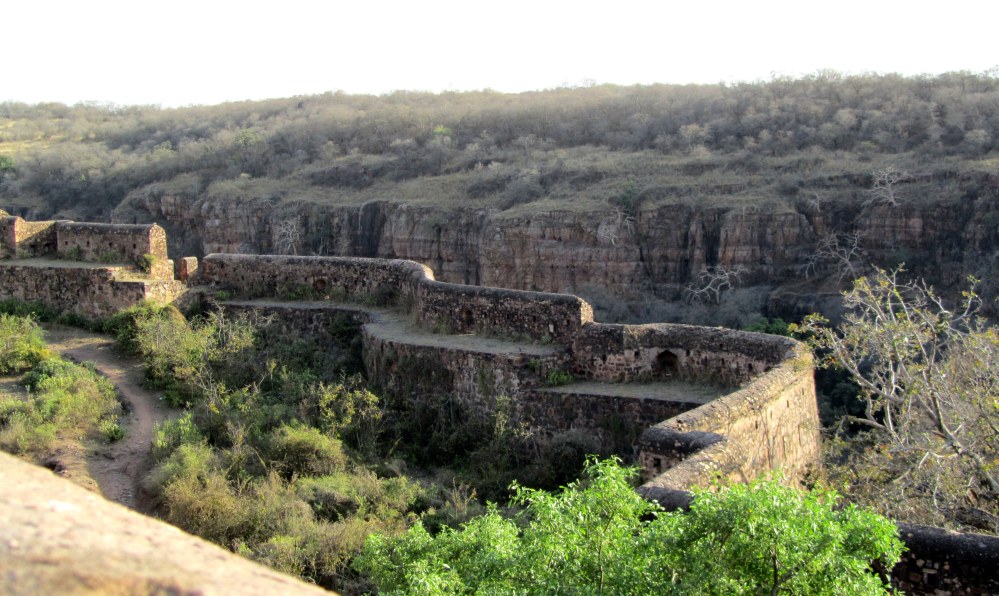
Ranthambhore derives its name from the forest ranges (or Ran) that run parallel on one side to the stronghold walls/pillars of the fort (sthamb) separated by a nallah (bhorr). The confluence of the majestic Aravalli and the Vindhya ranges, give Ranthambhore its beatific and picturesque landscapes. The magnificent fort atop the hills overlooks the many lakes, vast mountain ranges, surrounding forests and the national park. The walls, lakes, mosques and temple structures inside the fort bear a mute testimony to the countless conquers and surrenders by the kingdoms of Mughals and Rajputs that have reigned power in Ranthambhore. (info courtesy – Google)
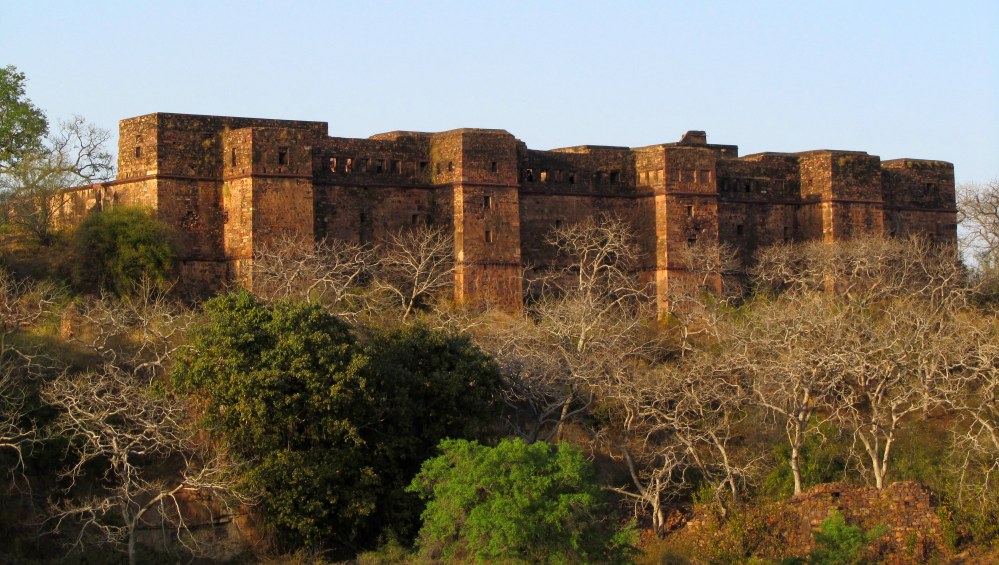
The fort lies on the Route no. 3 and as mentioned earlier all the trails pass through the foothills of the fort. Our jeep stopped at the brink of the safari route on the left and the lowest step of the fort on the right. True to the saying, ‘Athithi devo bhava’, our monkey friends were there for our welcome, most of them engrossed in activities best known to them while some curious ones getting into our empty and stationary jeeps for inspection. We started our ascent to the once prevalent Ranthambhore kingdom in the very premises. The fort had been long abandoned and wilderness played its role by engulfing most part of it with huge green trees and making it the most beautiful home to the peacocks, langurs, other animals and occasionally the leopards. After the last Rajput rulers, the tigers seemed to have established it as their kingdom. They are Kings of that part now; they enter, leave, wander and reside as per their will. Sighting the prowlers here is common.

We came across many temples built by the Rajputs, marriage halls and ruins of rooms. The Queen’s palace which once would have borne the splendour, eloquence, beauty and ecstasy, was ruins in most parts. We now entered our ultimate destination at the fort, the King’s palace. Built with several storeys, three of which were underground, the palace stood right on top of the fort with much of its structures intact. It was closed to the general public due to renovation work. But with the promise of not venturing too deep and making just a quick visit, the caretaker took us in. We saw the place where the Rajput queens performed Sati (an Indian custom where the wife jumps into the pyre with the death of her husband) after the death and loss of their kings to the Mughal Empire in the battle. Several rooms had been occupied by bats that hung upside down from the ceiling.
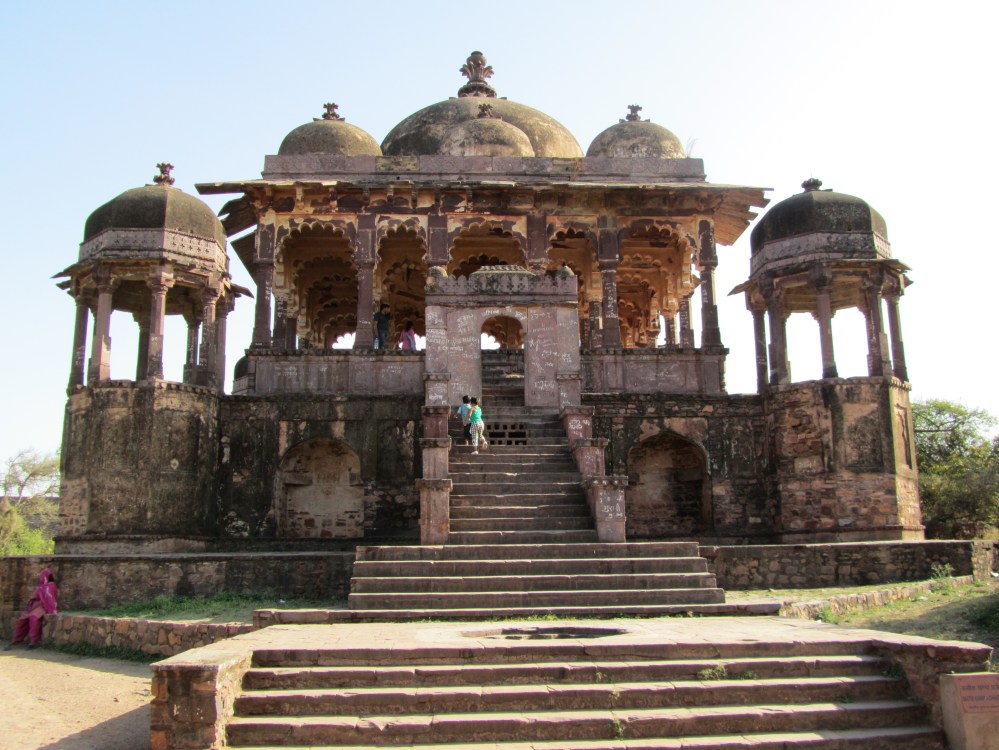 Symbolic Rajput and Mughal architectures on the doors, ceilings, walls were a treat to the eyes. It is believed that the King used to move from his palace to the queens palace and its chambers through the secret passageways known only to him. One never knew where one might find him. There was a tunnel that led to Chittogarh right from this fort. Abandoned and left to itself for nearly 80 years, the underground floors had been taken over, as per the locals, by gigantic snakes and other creatures of the dark. No one is allowed to enter the floors below for the fear of the unknown.

In all, the ancient toilet system, the dark passageways leading to – only the King knew where, the well built, well spaced, well air-conditioned rooms, the enigmatic overall architecture, the lake side and the forest side views left us enthralling, thinking about the people who might have had the privilege to live in this grand palace with magical beauty surrounding it.

Moving on we came across a makbara, a ganesh temple near which refreshments were served. We got a chance to feed monkeys there. Then we encountered something that was, I guess the first time for all of us in the wild, a peacock dancing with its colourful and radiant feathers opened up as an umbrella around it. It seemed to be showing off to the set of peahens gathered around; a courtship gesture, a moment that none of the cameras refrained from capturing. As we came back to the base of the fort we saw bold and beautiful peacocks perched on the fort walls and settled on nearby trees. It was their home after all.
18:30
We were to get into our jeeps, which had been thoroughly investigated in the past two hours by the langur troupe, when excited voices caught our attention on the other side of the big red gate at the fort base. We peeped through a window in a museum-cum-room adjoining the gate and could see 4-5 jeeps waiting in line, on either side of a narrow road that runs parallel to the road leading to the fort. A tigress with her cubs was about 100 meters from there and was supposedly going to pass by the route. The wait went on for 30 minutes. We saw a peacock gently land on a treetop nearby. There was an anxious silence. Then a forest guard informed that the tigress had settled for the evening somewhere in between and one by one all the jeeps left. We too retired to ours.
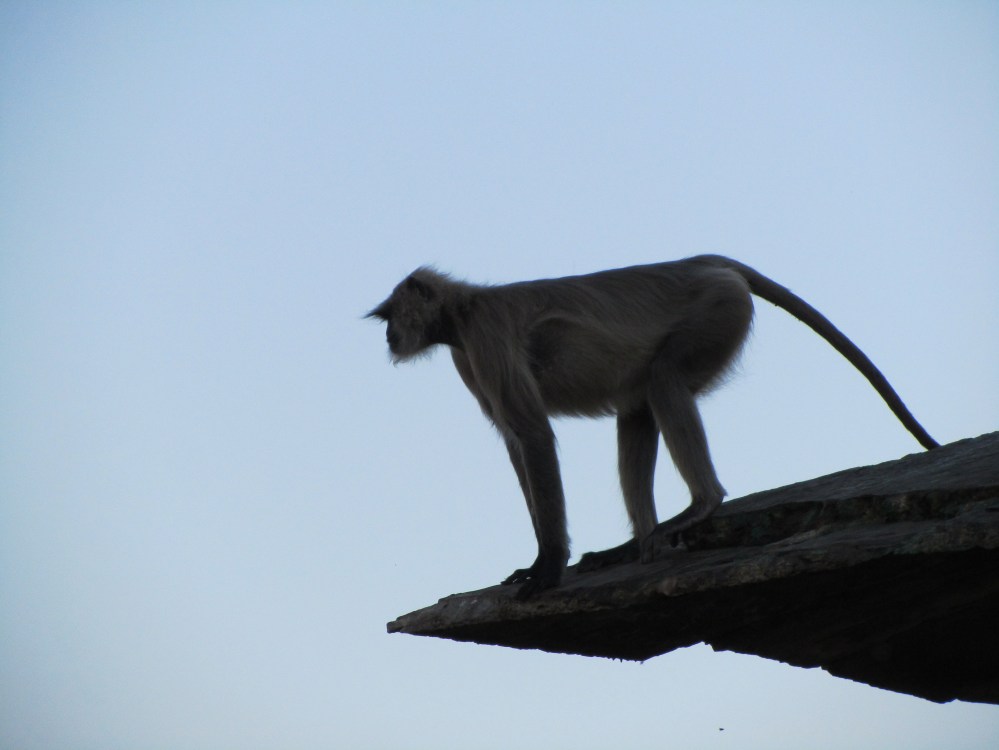
Ruins spread like dots throughout, gives Ranthambhore the mystique that few places possess. The entire forest cover encompasses the Keladevi sanctuary, the Sawai Man Singh sanctuary and the Ranthambhore National Park. The river Chambal flows tangential to the park separating it from the Central Indian state of Madhya Pradesh. The fort stands as a fortress for the National Park, the forests, the lakes and the resident wilderness that surrounds it, against the inhuman will of the mankind.
19:00
We stopped on the way to have a cup of hot tea. On reaching our tents, all of us loaded our packed bags into the jeep, waved goodbye to the good natured and amiable hotel manager and guard for a wonderful stay and started for the Sawai Madhopur railway station.
21:30
We dined at a restaurant near the station. Each one of us had a glass of thick and mouth-watering sweet lassi at a shop on the way.
22:50
We boarded the AC coach of the Bombay Central bound train, marking the end of a fantastic trip.
The days that we spent would be gone but the memories of our first wild jungle safari in the lands of the Rajput and the encapsulating beauty of Ranthambhore will be cherished by each one of us forever; an unforgettable experience that will always stay with us.
(This visit to Ranthambhore was some 9 years ago, this piece was written 8 years ago, wonder what took me so long to publish this, it can be only laziness :)…Waiting for a chance to get back to the forest that introduced me to a wonderful wild world & will always be special to me…)
 Walk the Wild...