Day 1 – April 3, 2011
04:00
Sweet, mellifluous voices woke us up as early as four in the morning, beating the golden sunrays that would have soon penetrated our cosy tents at Tiger Machan, Sawai Madhopur, a stark contrast to what we had been accustomed to until a day earlier and would be after we resume our monotonous life two days later.


Our sojourn to Sawai Madhopur and hence Ranthambhore had a sole purpose – catching a glimpse of our national animal, the Tiger, in its wild and free habitat. Ranthambhore Tiger Reserve is one of the nine early Project Tiger Reserves, an initiative started in 1973 by our then Prime Minister, Mrs Indira Gandhi, who realised the importance of preserving and protecting the habitat for tigers in India. India was the first to start an initiative of this kind to check the declining numbers of its Tigers.
06:30
We started our planned tiger hunt in the morning. A canter, which could accommodate sixteen visitors, was waiting at our hotel gates. As we entered the Reserve gates, our anxious eyes were met by the most common occupants of the Jungle, the black-faced or Hanuman langurs. We saw some ten of them sitting in row, on the high walls, greeting each and every visitor. Unlike the pestering monkeys that we find elsewhere, these cousins of theirs were highly tolerant and satisfied in a world of their own, occasionally playing around and glancing at the numerous visitors that made their way into the National Park.


Ranthambhore, unlike the general image of the forests that we have in our minds, is a dry deciduous forest, occasionally interspersed with green trees. The park is open to the visitors in the form of what is described as route no. 1, 2, 3 and so on till 8. We were headed for route no. 4 that morning, assigned to us at the safari booking counter. The entry point for all the routes is through the foothills of the valley that hold the magnificent fort of Ranthambhore. From there on, it is a 10-15 minutes drive to the main gate. The forest road ahead split into the above mentioned routes. Route No. 4, known to be a great one for its tiger sightings welcomed us with fresh pug marks of a tiger who had passed that way some hours ago. With this knowledge and mounting excitement, we followed the pug marks diligently until it led us to a point beyond which our canter could not carry us further.
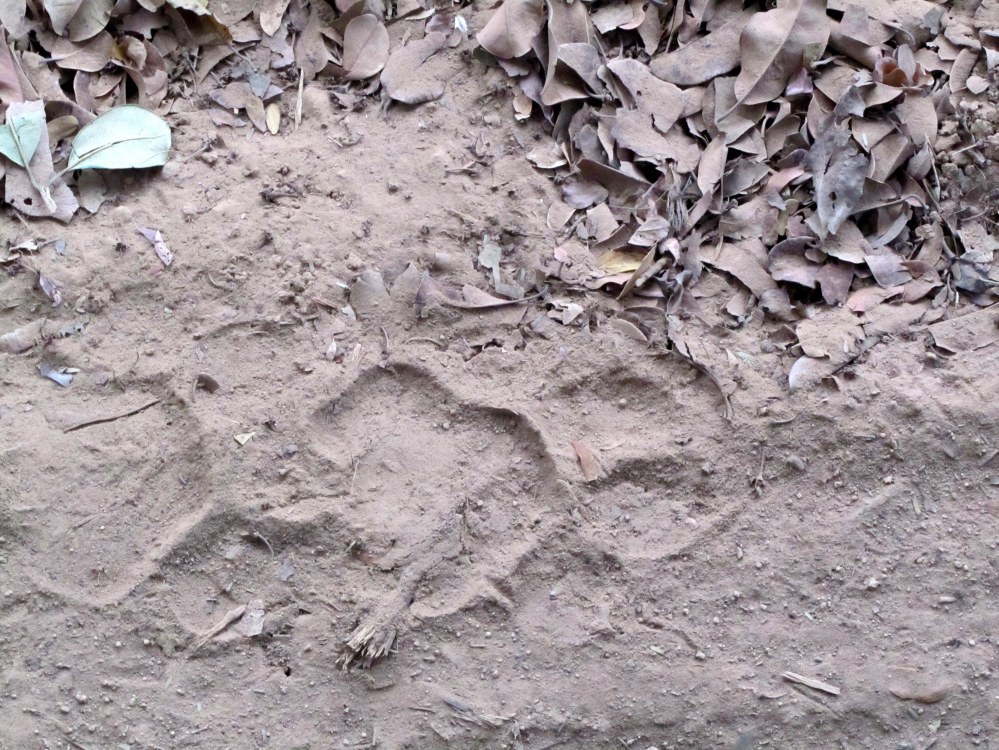
The tiger trail had led us through the woods, open and dry grasslands where we ran across our first ungulates for the day, the Sambar (or the Indian deer). They seemed a bit disturbed by our sudden appearance but got on with their activities once they realised that we were none other than similar curious lot on vehicles, which they had been accustomed to, intruding their private lands now and then. Moving ahead, we saw herds of Chital (or the Spotted deer), their ears alert and sensitive to the slightest movement around them. Some were feeding on salt licks (small stones full of salt and other minerals), which were intentionally placed there for the ungulates. The route had lakes which attracted many migratory birds, apart from the ones resident there. Painted / black stork, wholly necked stork, the white-throated kingfisher, the crested serpent eagle and a variety of ducks were spotted.
Unable to follow the trail further which was lost in the thick undergrowth of the valley, our guide tried to follow other methods of tracking a tiger. The call of a frightened deer, the haunting cry of a peacock or the excited and loud warning of the langurs alerted the inmates of the approaching predator. We stopped at a designated refreshment point. A rush of black and yellow wings on our canters, indicated that were not alone. The Indian or the Rufous Tree Pies were all over hunting for foreign food in the jungle. Nothing edible could escape their vision. Fearless by the alien presence, they gently landed on hands outstretched with chips and other items and started munching on them.


09:30
After nearly two hours, we were back to where we started, without any luck with the big cat. We saw a vulture resting high and peaceful near its nest on the hilltop. One loses complete connect to the outside world inside the jungle. The beauty of the wilderness and its inhabitants encapsulate the visitor’s mind making it numb to other facets of life. But for the tiger, we enjoyed our first jungle safari thoroughly and vowed to be right back for the evening adventure.
15:30

Once again we entered the Ranthambhore Tiger Reserve gates for the slated evening safari with anxiety and excitement alike. Route no. 5 offered a more verdant part of the forest than the comparatively dry route no. 4 which had a banyan or peepal tree making an occasional appearance. Spotting red-green cacti at regular intervals was common. This part of the forest had more lakes than its predecessor.

Inside the forest, we got down near a lake and walked some distance on what seemed like a wall that had split the lake, like a dam, into two unequal portions. Considering this to be a great opportunity of getting down and walking inside a forest full of wild animals, we merrily marched to the other abrupt end of the wall, until our guide casually warned us not to venture too far as the lake was full of the last living survivors of the dinosaur, the crocodiles. This sudden information thus passed on, sent shock waves across the otherwise calm minds. Instinctively, fear gripped our hearts, as everyone started looking around only to find that the uneven rock-like structures were actually the marsh crocodiles, basking in the sun. This route had more lakes laden with the reptiles than other areas, we were informed. At that very instant an enormous croc dived into the water from the tall grasses. We started looking at the marshy waters with nervousness; fear and awe for the creature, as it disappeared. As we started back to our canter, we saw the pug marks of two cubs that according to the local forest officer had lost their mother only a couple of days ago to a terrible disease. With pity in our hearts, we moved on. Sambar and Chital were in abundance in this part.
A rumour of a leopard, to be more specific shadow of a leopard on the hilltop, under the tallest tree visible, seemed to do the rounds. Neither could any of us determine the tallest tree of all and nor could we see the shadow, leave alone the leopard. As we moved on, a passing vehicle informed us about a tigress being sighted on Route No. 4. Changing our assigned route was not an option as it was against the park rules. We waited, for our satisfaction, just to ensure that we don’t miss the tigress, if she decides to pass by this way. After establishing that there was indeed nothing to wait for, we started towards the exit point.
18:30
We gathered from the guide that the female big cat sighted, was none other than the famous Machhli of Ranthambhore, who had many accolades inferred upon her by the National Park and many outside Wildlife Institutions. Her battle with a huge marsh crocodile, over a deer corpse, where she emerged victorious snatching the deer out of the waters is known to all wildlife enthusiasts and was broadcasted across on our favourite wildlife channels. Machhli, also known as the Tigress of the Lakes, is well known for her public appearances among other big cats in the jungle. Tired, sad and cursing our luck we returned to our tents.
(to be continued…)
 Walk the Wild...