Day 3 – Jan 26, 2015 – Happy Republic Day!
04:30 AM
In the land of the rising sun, the sun understandably doesn’t tolerate too much sleep. Technically, it rises an hour before the actual IST. But I feel, it just waits there to peek-a-boo and light up the whole sky. At the stipulated hour or on many occasions even before time, it sends out its focused rays to wake up the entire forest. And once the forest is awake you simply can’t sleep. So we were up, sitting by the river, some brushing, some just letting the cool breeze hit their frame, some already sipping tea. I was left wondering how I came about waking up to such a beautiful morning. Being the only two girls in the group, we walked a bit into the green cover for our morning ablutions. For the first time in my life, I covered it like the cats do :).
We discovered that the area which had been chosen for performing this unavoidable morning routine was bang opposite to the home of Hoolock Gibbons, the only ape species found in India. We could hear their shrieks and laughs. We obviously hadn’t carried our cameras and so we missed clicking the only Gibbons that we saw in the entire trip. They were far but we could see their outlines clinging from branch to branch and jumping from tree to tree. Satisfied we came back to the camp to announce our first sighting of the day. The camp grew energetic and started in that direction with cameras. But the apes had moved on by then. We decided to move on too. A stonechat was perched on a tall grass and appeared as if it was planning its day. Plumbeous Redstart, Wagtails were going about their morning routines. After breakfast, we wrapped the camp and started off for the first day of our trek.
10:00 AM
This was my first full-fledged birding cum trekking cum camping trip. And the destination being the dense forests of North East defined it all. The birds here had varied characteristics. First of all, to our frustration, they were very shy; but that was on account of the hunting and poaching, Moshang informed us, so nothing could be done. Secondly and annoyingly, they seemed to attain speeds of tornados and torpedoes, when we neared them, just whizzing by, before eyes could even know. Thirdly, they were of such brilliantly camouflaged colours that when the eyes managed focus, the focusing systems in cameras failed miserably. Fourthly, our situation appeared to be the reverse of the phenomenon of lightning and thunder; we first heard and only then, if lucky, saw something. The birds were either teasing us or on a positive note, testing us. Either ways our patience was being subjected to immense pressure right in the first few hours of birding.
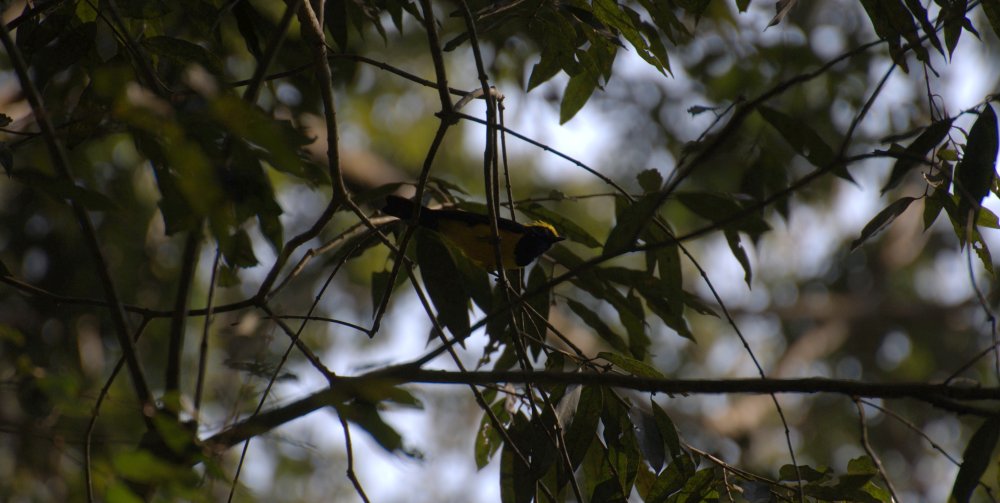
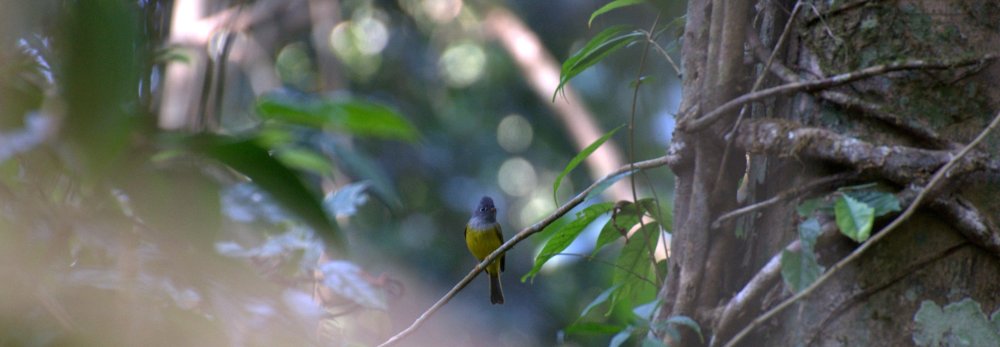
And finally, there was a breakthrough. The famous Sultan Tit with a yellow crest and black body waited for some milliseconds before flashing ahead. A tree full of Blue-throated Barbets, some ten of them, was our next find. After an hour, a Grey-headed Canary Flycatcher caught my attention. It sat for some time, on a nearby branch, as my camera managed focus.
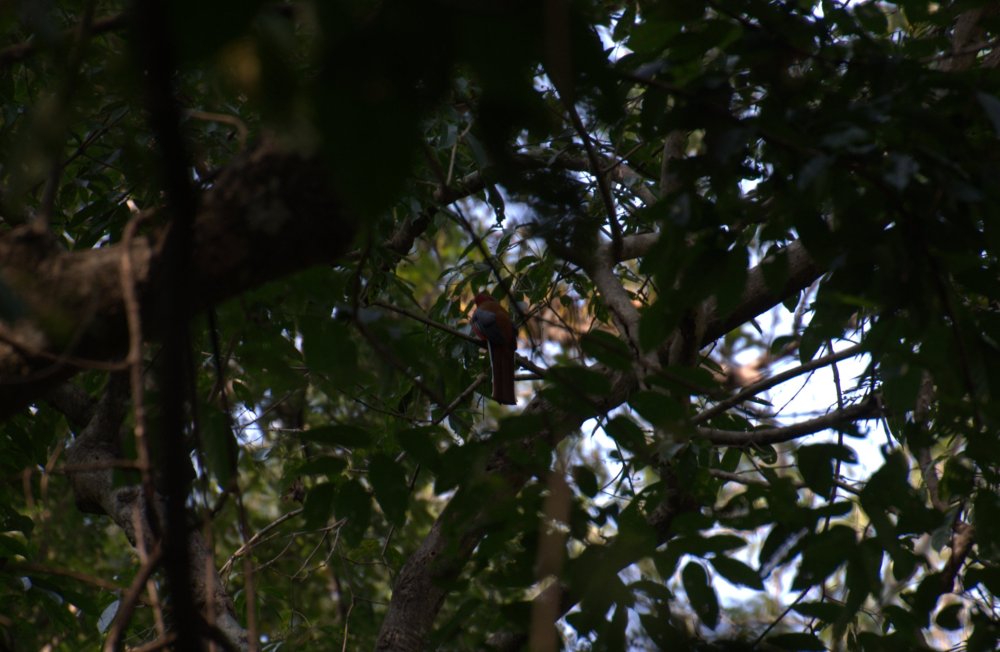
Another hour and we were in for a treat. The Phantom of the East or the Santa Claus bird as they call it, the Red-headed Trogon surprised us with its sighting. Both male and female birds were perched high on different branches and facing the other side. We could manage only long shots of the back of the bird. Its sighting was considered very lucky among the local folks and hence, our guides were visibly energized and continued the bird hunt with renewed vigour.
Camp II – Hornbill (5km trek)
04:00 PM
We reached Hornbill point, the next camping site. It was called so, as it was the nesting ground and hence sighting ground of Hornbills. Five, ten minutes into the trail, we heard a sudden thunder like that of a helicopter taking off; and not just one, so many of them. Imagine our shock when we got to know it was the wings of the Hornbill that generated such a noise. Austen’s Brown Hornbill was perched far away, we saw it through binoculars. We did a little more of birding and came back to the camp. A pair of Wreathed Hornbills flew over our camp.
There was yet another reason for this camping location. The huge trees facing our tents were the hunting and foraging grounds of the Namdapha Flying Squirrel. It was an arboreal, nocturnal animal. So after a dinner of rice, dal, paneer and tinned rosgulla, we were out with torches, standing at a distance from the massive tree, waiting for the arrival of its star attraction. And the star landed on time, smoothly glided and positioned itself at a branch visible to all of us. High beam torches flashed at it. It was confused for few initial seconds and then it started fruity dinner.
As the name suggests, it is endemic to the area. In fact, it is in the IUCN red list of Critically Endangered Species. A very small population exists in a very confined area. Poaching is attributed to be the main reason. This squirrel glides with a help of a parachute-like membrane stretching from wrist to ankle. They open up when it glides from one branch or tree to another and the act seems like it is flying. It couldn’t justify its title of squirrel to us because it was a bit too fluffy and bulky and dimension-wise not so squirrel-like (compared to the normal ones we had seen). It had a shiny coat, tawny on top and creamy white below and a long and bushy tail. Although, aware of the torches and seven pair of eyes staring at it, it merrily continued dining, devouring fruits from one branch and then next. It merely didn’t consider us a threat and was not bothered by our presence. Satisfied, we went back to our tents.
The land of the rising sun is also the land of the early setting sun. So night fall is early too. And I was getting accustomed to sleeping alone in that dark tent.
(to be continued…)
 Walk the Wild...