(continued from ‘The Mother of ALL Forests…Prologue’)
Day 1 – Jan 24, 2015
There was still time for the lazy winter sun to rise. It was quite dark outside. Bags packed and loaded into the cab, we were off to the airport. Traffic at 4:00 AM in the morning! Whoa! It can happen only in Mumbai. I heaved a sigh of relief only after the traffic infested stretch ended and we sped towards the airport without any other hindrance.
Journey I – Mumbai to Dibrugarh
Source: Mumbai. Destination: Dibrugarh. Sounded simple!
But that was not meant to be accomplished so easily. Jet Airways had bestowed us with an exceptional itinerary. They somehow seemed to have known our trek plans and voluntarily took it upon them to test our endurance and prepare us for the onward trip. So, after having our identities established at the counter, we received a bunch of tickets per person. We were to fly from Mumbai to Ahmedabad, deplane and board the next flight to New Delhi, deplane and board another flight to Guwahati that would thankfully not require deplaning, but some amount of waiting and then obediently proceed to Dibrugarh. Phew!
We started our day long journey.
The route from New Delhi to Guwahati was most beautiful as it passed over Nepal-Sikkim border where lay the Himalayan Kangchenjunga Himal range. We could see the snow-clad Kangchenjunga peak which is the third largest in the world at a height of around 8586 m. The mountains towered into the clouds. It felt as if we were in the heavens. My thoughts immediately drifted to Mt. Everest. What would she look like? Each one of them was so massive and majestic. Awestruck, eyes were glued to the window panes. Further ahead, the mighty Brahmaputra came into view announcing the arrival of Guwahati.
By this time, we already felt as if we were hiking through states via airports. A great start to a trekking trip we surmised. With the shortest wait of 45 minutes, we finally reached Dibrugarh Airport at 4:30 PM.
Interestingly, Dibrugarh Airport at Mohanbari operates only five flights a day. Ours was the last one for the day. As we stepped out, we were surprised to see the lights being switched off and the airport being shut down at just 5:00 PM. From a city that never slept to a city that was closing so early, it was a weird change for us. A new time zone beckoned us and Mumbai took a back seat in our minds for the moment. We had taken off from Mumbai in darkness of the dawn and landed in Dibrugarh in the dimness of the dusk. As the sun retired for the day, two SUVs loaded with rucksacks and three people each excluding the driver started a race against time.
Journey II – Dibrugarh to Miao
A minute into the road journey and my mind was completely occupied by the thrill of being in the land of the one-horned Rhinos, the roaring Brahmaputra, the evergreen Tea and the resilient Assam Rifles! A sense of pride flooded inside me.
About Assam Rifles (courtesy Google): They are India’s oldest paramilitary force established in 1835. The 1640 km long Indo-Myanmar border is guarded by the Assam Rifles. It’s a huge force having grown in the years. They are also entrusted with a variety of other tasks including peace keeping inside disturbed areas of the north eastern states. As their motto suggests, they truly are the ‘Friends of the Hill People’.
Journey II (contd.): From the Dibrugarh airport at Mohanbari we went through Chabua town, Tinsukia, Makum, Digboi, Margherita, Ledo, Lekhapani, Jagun, Namchik, Kharsang and finally Miao (in that order). Incredibly significant, this route was literally a ride through the pages of our history textbooks.
Super history on the way: Travelling back in time to somewhere around 1791, Tinsukia, then called Bangmara, was the capital of the Muttack Kingdom, ruled by the Ahom kings. Today, Tinsukia holds Assam’s largest railway junction.
A plant called ‘Camelia Asamica’ discovered by the British, was the reason for India’s first tea plantation that started in Chabua near Tinsukia in the 1820’s. Chabua gets its name from ‘Chah’ ‘bua’ that translates to ‘tea’ ‘grow’. Camelia Asamica is the Assam CTC Tea that we know today.
The British struck crude oil and Asia’s oldest oil refinery was built in 1880’s at Digboi. Margherita, also known as the Coal Queen of Assam, was christened by an Italian engineer Paganini in the honour of the 19th century, Queen Margherita of Italy.
The British seemed to have been really busy in the 19th century in India with a lot of discoveries in Assam; from tea to crude oil to coal and then construction of respective plantations, refineries and mines.
Moving on, we travelled through the much renowned and historic Ledo Road which is now called the Stilwell Road. The road starts from the Ledo railway station, which happens to be the easternmost railway station of India. The road connects India, Myanmar and China. It was built by the Americans during World War II to supply goods to the Chinese, as an alternative to the Burma Road that had been cut off by the Japanese.
Probably, one of the oldest laid roads and rail lines, the railways and roadways rode together here!
After passing through the military camp at Lekhapani, the town of Jagun, the Stilwell Road transcended into the Jagun-Miao Road, giving our travel a new direction.
At around 9:30 PM, we crossed an old metal bridge on the Dihing river and stationed our SUV outside the Namchik Check Gate, for a formal entry into Arunachal Pradesh.
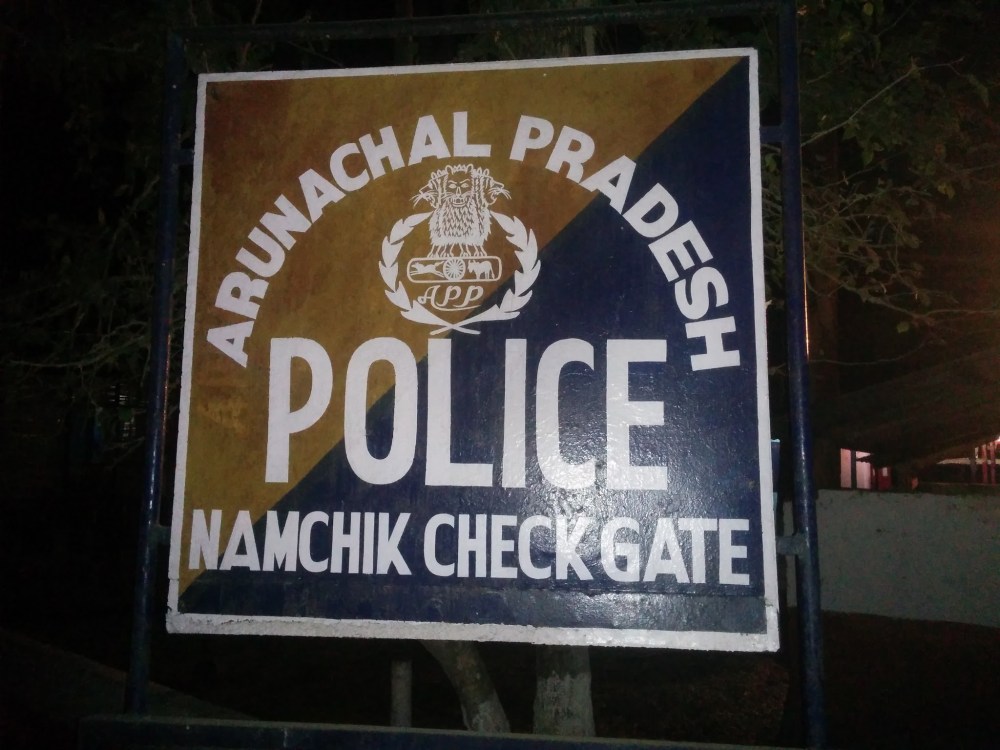
Assam bid us a pleasant journey and with the sound of the gushing water beneath us, Arunachal heartily welcomed us. Then, through the town of Kharsang, we finally reached Miao. The Miao-Vijoynagar Road took us to our stay for the night, a beautiful resort, Namdapha Jungle Camp, as we would surmise with the morning lights. As the resort neared, we could hear the sound of flowing water against the stillness of the night. Initially, it sent down a chill but later we became used to it and it lullabied us to sleep in the night.
Accommodations were peculiar. Facing us stood three giant-sized bamboo huts with thatched roof, standing at a height from ground and with a small porch seating two chairs which faced a large garden. It was spacious with two beds, a bath, a window and a table to keep luggage. The entire camp had only three huts. It felt as if it had been made only for the six of us. We quickly stuffed ourselves with food and got ready for a good night’s sleep, as it would be our last one on a cosy bed for at least a week.
(to be continued…)
 Walk the Wild...